Although my brother and I played Pong and eventually Atari as children, our mother’s concern for screentime in the 70’s was real. She noticed that it caused us to become zombies, and it took time away from books, play and chores. So, she would hide the power cord, the aux chord, or the rabbit ears TV antenna before going to work. My older and wily brother always found it and we snuck in an extra hour than we were supposed to, but we always went outside to play cops and robbers on our bikes and usually did some chores to help around the house.
Studying engineering at CU Boulder in the early 90’s was very exciting. We had multiple labs with computers named after music composers. We were using software, building programs (in Fortran & Basic) and building elaborate spreadsheets. But it was college, in Boulder, and I was 18… I wasn’t exceeding my screentime.
It wasn’t until I had my own children that I worried about screens again. My husband and I took the road less traveled by taking the Wait until 8th Pledge and allowing only a Kindle Fire. I had seen how the screen and games would affect their mood, shorten their attention span and took away from the benefits of reading, music, outside play among other things, yes, like chores. With heavy training, only now as sixteen- and eighteen-year-olds, they are “in charge” of their screen use, unless of course, it is abused, unsafe, unhealthy or getting in the way of other priorities (like reading, music and chores).
Having taught middle and upper school math in the early 2000’s and again a decade later, I’ve had to problem solve new ways to teach given the growth of technology. My goal was and will always be to engage students and help them build the stamina and confidence to problem solve.
With the alternative ways to gain knowledge, literacy has become the new math. It feels like I’m hearing that response of high school math students, “when am I ever going to use this?” Perhaps reading and literacy were always like math, but I took it for granted. It is problem solving and it takes work and time to achieve literacy where you can use, comprehend, manage, and analyze information safely, effectively, and responsibly.
I worry about how little (and how thorough) students appear to be reading. My kids have very few textbooks and when I inquired at school, the math department head said, “they are available”. Many colleges (and employers) are challenged when young adults can barely read and comprehend primary source documents. I wonder who is concerned about this and who is not, and why.
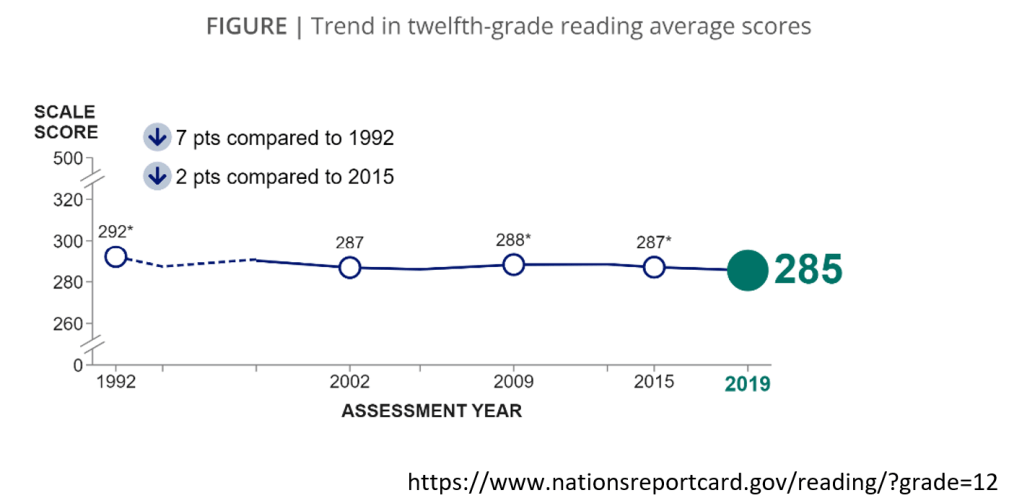
Although the National Assessment of Educational Progress (NAEP) has the largest cohort of student data from urban schools and is the only source of nationally representative results of twelfth-grade student achievement, I was disappointed about the number of schools participating (~3,000 schools out of ~24,000). Clearly there are many considerations, but when the organizations and institutions that follow K-20 education concur with the results, the data is increasingly validated. According to NAEP, two-thirds of U.S. high school students are unable to read and comprehend complex academic materials, think critically about texts, synthesize information from multiple sources, or communicate clearly what they have learned.
Do you think we are moving to a world where long term memory, attention, and deep comprehension (that comes from problem solving) is only needed for a small set of society? Who needs it? Who doesn’t? What does literacy look like with YouTube and AI? Can we gain agency without literacy? Is it possible to gain enough knowledge without literacy to build successful civic, professional, and social futures? As a GenXer, I don’t see an option for illiteracy, anywhere, what do you see?


Leave a Reply